When I was very much younger, I used to miss the first half of concerts whenever a symphony by Bruckner or Mahler was programmed, in order to approach these enormous works with fresh ears, ears whose attentive energy had not been diluted by the experience of listening to whatever had been programmed as the first half of these concerts. So when I read that the SSO’s gala concert to open their 2026 season was as described in the title above, I thought: How wonderful – an entire concert devoted to just one vast masterpiece, Mahler’s Das Lied von der Erde. So I was taken aback to discover, on arriving at the concert hall of the Sydney Opera House, that, no, I was mistaken – there was indeed to be a first half to this concert.
It began with a composed Welcome to Country, written by Adam Manning, a Kamilaroi man. Titled Rhythmic Acknowledgement of Country, it was a short but powerful, percussive piece, in which the entire string section played clapsticks. Had this been the only piece to precede the Mahler, the connection between this acknowledgement of country and Mahler’s panegyric to the earth would have been seamless. But no, there was more.
The piano concerto by Chen Qigang consisted of various pentatonic folk-tunes from the composer’s childhood in Beijing, wrapped in a veil of sound mostly derived from the slow opening Messaien-like chords. It was beautifully played by Jean-Yves Thibaudet, and persuasively accompanied by Simone Young, and the audience responded enthusiastically to their performance. The composition itself, however, seemed to me musically so thin on the ground as to be almost facile, particularly in the context of the immense sophistication of Mahler’s work.
Then, astonishingly, pianist and orchestra gave a long encore in the form of a fantasy on the song “I’ve got rhythm” by Gershwin. While this was much more energetic than the piano concerto, any competent jazz pianist could have outshone the composer here. Being almost half the length of the concerto, this fantasy saturated my ears in just the way I was hoping to avoid, as I described above. And while some connection between the pentatonic basis of the concerto and the occasional chinese-isms of Mahler’s work could be made, the same could not be said of the Gershwin. Its inclusion in this concert, while certainly an opportunity for Thibaudet to display his remarkable and subtle tonal palette, was to me frankly baffling.
Then, after the interval, the work we had come to hear, one of the greatest musical works of the entire Romantic era, began.
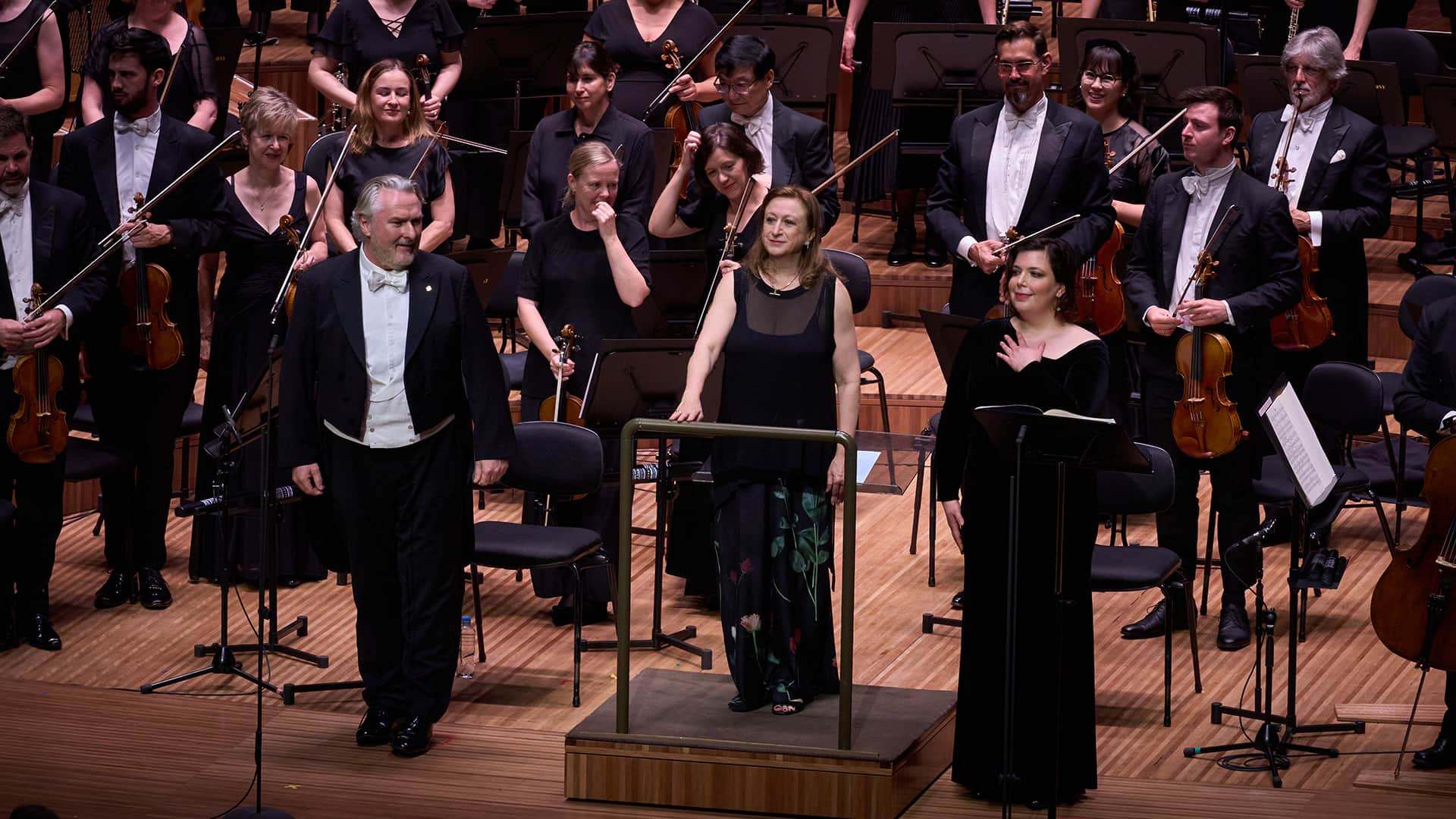
I had recently heard Simon O’Neill singing the title role in Siegfried, also under the baton of Simone Young, so I was expecting finally to hear a tenor who could sing loud enough to be heard over the sometimes overwhelming orchestral textures of the first song, Drinking song of Earth’s sorrow. And I was not disappointed! Both Young and O’Neill launched into this piece with an operatic full-throated-ness that made one’s hair stand on end. O’Neill acted and sang the entire score, even the bits in which he was not actually singing, and Young drew textures from the orchestra with absolute fidelity to the emotional complexity of Mahler’s music. Her approach to this score was powerful and dynamic, yet also in a mysterious way liquid and transparent, so that I, who have loved this work for 60 years, heard lines in the music that I had never heard before.
O’Neill was delightfully comic in the enchanting third song of the work, Von der Jugend, in which the world where poets can exchange poems in the course of casual conversation works just as well when seen upside down in the reflection in the water; and he was very drunk in the fifth song, Der Trunkene im Fruhling, in which the singer sometimes seems to float, gravity-less, in the vast space between the piccolo and the contrabassoon.
The mezzo-soprano Alexandra Ionis has a warm, deep purple voice with a richness and depth of sound which suited well the second song, Der Einsame im Herbst, and even more the final song, Der Abschied, Mahler’s sublime farewell to the world. Mahler uses a large orchestra for Das Lied von der Erde, and indeed for most of his symphonic works, but typically uses the instruments sparingly, preferring a wide variety of chamber-music-like sonorities to a general tutti sound. This is nowhere more true than in the second song in Das Lied, in which single instruments play scales in contrary motion while the soloist sings widely spaced phrases over the expressive, spare orchestral textures. Ionis’ gorgeous voice blended beautifully with these textures, but I occasionally missed the sense of connection between phrases which was so evident in O’Neill’s interpretation of especially the first song. Nonetheless, by the time she sang the final passage (Sonne der Liebe…) she had the audience hanging on her every note.
The orchestra was amazingly brilliant in the fourth song, which showed off Ionis’ velvety lower register. But it was in the final song, a deeply introspective meditation on parting and death, that her vocal and interpretative powers came into their own. In the first section, where the agony of waiting is intensified by the incredible beauty of the natural world around the person who is waiting, she sang with a measured intensity that maintained tension right through the second section, up until the climactic conclusion of the song, where she allowed this pent-up intensity to overflow in a quite astonishingly expressive vocal cantilena. I am sure that mine were not the only eyes in the audience also to overflow at the close of this wonderful performance.
For wonderful performance it was. Young, O’Neill, Ionis, and indeed every member of the orchestra understood how to let this music crack open the psyche, yet hold us there in ways that can transfigure our souls. This kind of music is so not entertainment – rather, it is a window into the infinite, a vehicle for transformation.
There are more performances – it is not to be missed.
Event details
Sydney Symphony Orchestra presents
Simone Young conducts Mahler’s Song of the Earth
Director Simone Young
Venue: Concert Hall | Sydney Opera House, NSW
Dates: 25 – 28 February 2026
Bookings: www.sydneysymphony.com